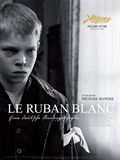
The White Ribbon review

:. Director: Michael Haneke
:. Starring: Christian Friedel, Ernst Jacobi
:. Script: Michael Haneke
:. Original Title : Das Weisse Band
:. Running Time: 2:24
:. Year: 2009
:. Country: Austria
:. Official Site: The White Ribbon

  
   AddThis Social Bookmark Button


One recognizes great directors by their capacity to renew themselves without abandoning their signature style or their faith in their art. Michael Haneke is among these authors and each one of his films is accompanied by feverish anticipation and suspicious curiosity. Knowing the Austrian filmmaker's taste for shocking spectators, we can't help but be on guard, as the provocative director loves to make us face our most vile instincts and always reserves some sudden moment of violence that takes us by the throat.

With The White Ribbon, he reverses our expectations, delivering certainly his best film, a work that summarizes his oeuvre while being original at the same time. If there is violence, it is never explicitly shown onscreen. On the contrary, it remains off-screen, materializing only though ellipses and dialogues involving a sense of hierarchy, whether in a couple, a family, a community or a village. Underneath its apparently peaceful structure, the film reveals stories of jealousy, incest, humiliation, frustration, anger and shame which instill a constant tension lasting close to two and a half hours; for example a simple scene where a child asks his father to keep an injured bird he found turns into a moment of torment, where the fear of authority crushes any inclinations towards emancipation and freedom of expression.

Striking from the start is that it is a period film (set in early 20th century) while Haneke clearly aims at making us question our contemporary world. He shows us strange events occurring on the eve of World War I in a peaceful village, filling the screen with beautiful and ample black and white images.

Opening on a strange accident (a doctor's fall from his horse caused by a cable mysteriously tended between two trees), the film unfolds slowly, imposing its unvarying rhythm while allowing the audience to witness a series of incidents. Initially inconsequential, the incidents gain in strangeness (decapitated cabbages, a handicapped child found mutilated, etc …) and in gravity. The film will never reveal the identity nor the motivations of the culprits, but it doesn't matter, since the search for a truth which will be always concealed isn't what should interest us here. Rather, the force of the director's mise en scene lies in the treatment of usual themes in a completely innovative way, without excess, but with the precision of a goldsmith. Once we're grabbed by this cinematic device, the film never lets us go, taking us in its strange universe where the questions matter more than the answers.


  Moland Fengkov


     Hidden
     Time of the Wolf
     The Piano Teacher



  + MOVIE GUIDE
  .: Film Spotlight
  .: New Movies
MOVIE REVIEWS
A B C D E F G H
I J K L M N O
P Q R S T U
V W X Y Z
  + FILM FESTIVALS
  .: AFI Fest
  .: Cannes Festival
  .: COL COA
  .: LA Film Festival
  .: LA Latino Festival
  .: more Festivals
  + CULT MOVIES
  .: Cult Classic
  .: Foreign
  .: U.S. Underground
  .: Musical Films
  .: Controversial Films
  .: Silent Films
  .: Spaghetti Westerns
  .: Erotica
  + RESOURCES
  .: Download Movies
  .: Movie Rentals
  .: Movie Trailer
MAILING LIST
Get our reviews by e-mail
We'll never Spam you
 
| About Plume Noire | Contacts | Advertising | Submit for review | Help Wanted! | Traffic | Privacy Policy | Questions/Comments |
| Store | Work in Hollywood | Plume Noire en français [in French] |