Time of the Wolf movie reviewTime of the Wolf review


Time of the Wolf


        :: New Films
     :: Now Playing
     :: DVD releases
     :: Preview Guide
     :: Browse reviews


Free - Get all the new reviews by e-mail
 
Powered by YourMailinglistProvider


Time of the Wolf
Directed by Michael Haneke

Starring: Isabelle Huppert, Béatrice Dalle, Patrice Chéreau, Rona Hartner
Script: Michael Haneke
Original Title: Le Temps du Loup
Running Time: 1:53
Country: France
Year: 2003
Official Site: Time of the Wolf
Following his provocative Piano Teacher, Michael Haneke has chosen to study the evolution of social codes following a disaster. While the film never reveals what happened, what interests the director here is the aftermath rather than the cause, as the absence of any police or military presence seems to point at some conflict-type event.

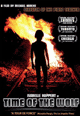
Time of the Wolf follows Isabelle Huppert, in an almost ghostly performance here, and her children as she looks for a place to survive or a trace of civilization, following the murder of her husband by an intruder in their country house. After wondering through desolate areas, she ends up in a train station converted into a camp. Through her character, we then witness how man tries to rebuild society from scratch.

Based on Codex Regius, an old German poem which describes the few moments before the Ragnarok (the end of the world), Time of the Wolf is certainly the least spectacular entry in the post-apocalyptic sub-genre to which it—unofficially—belongs. Haneke, one of the most cerebral contemporary filmmakers, explores moral issues as well as intellectual and social mechanisms associated with the absence of any officially defined society. His work is free of any of the grotesque ingredients that ridiculed the genre, but by opting for a serious contemplative approach, he offers his flank to criticism as his film doesn't bring any profound revelation to the sub-genre.

Anarchy, struggle for power, lack of moral values and racism plague this new world, which has been reborn into some medieval state. From the organization of the camp to the replacement of money by exchange and the omnipresence of beliefs and legends—hence the title—, everything suggests that the aftermath of chaos would lead to a medieval society rather than to a more primitive state. If this idea isn't new—even a Hollywood popcorn flick such as Reign of Fire went in the same direction—the fact that the film is based on a medieval poem doesn't clarify the position of the director to know if he's really trying to promote this idea or is just transposing the medieval setting in modern times.

The emphasis on nature rather than on decors conjured to an almost contemplative pace turns his film into a pretentious and somewhat ridiculous piece as, contrary to the achieved works of directors such as Andrei Tarkovski (Solaris, Andrei Rublev), Werner Herzog (Aguirre, the Wrath of God, Nosferatu the Vampyre) and Krzysztof Kieslowski (The Decalogue, The Three Color trilogy), there is no intellectual breakthrough, poetry or metaphor hiding below the quiet surface.

Time of the Wolf is a rather pointless entry in the sub-genre, which still reveals some rare gems as the slightly absurd and poetic After The Apocalypse showing at festivals attests.

  Fred Thom

     Hidden
     The Piano Teacher
     French Film Reviews

     French Cinema: From Its Beginnings to the Present,
       Remi Fournier Lanzoni, Continuum Pub Group, 2002.
     French DVD Store


| About Plume Noire | Contacts | Advertising | Submit for review |
| Contributors Wanted! | Traffic | Store | Mailing List | Privacy Policy |

Copyright ©1998-2008 LA PLUME NOIRE All rights reserved.


Time of the Wolf DVD soundtrack poster book store
  AllPosters.com

French Cinema: From Its Beginnings to the Present
Order This Book