|
|
|
|
|
|
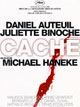
While I'm sure cerebral director Michael Haneke was aware that his film would provoke some kind of intellectual controversyas is often the case in his filmography, he must also have known that with his latest offering, he was taking the risk to alienate a big part of the audience who would unavoidably misread it. You might call this an elitist oeuvreHaneke has always made it clear that his films are destined for intellectual cinephilesbut what matters is that, under its mainstream facturea star cast plus some suspenseHidden is a brilliant film that will only reveal itself to audiences familiar with his work and recent French history. Hidden centers around a couple, George (Daniel Auteuil) a TV host of literary showsthink real-life Bernard Pivotand his wife Anne (Juliette Binoche), who receives anonymous videotapes from somebody who's been filming them. As they start to drift apart, victims of the stress resulting from this harassment, a forgotten and shameful element from George's past will resurface, taking the audience on the direction of social and filmmaking commentary while bringing them to a dead-end, at the strictly narrative level. France and its shameful historic past While international audiences might be aware of France's involvement in Northern African countries thanks to Gillo Pontecorvo's manifesto, The Battle of Algiers, what they don't know is that some innocent victims of this war who were on French soil, have beenvoluntarilyforgotten, because of the shame involved: during the conflict, a group of Algerians was drowned in the Seine in Paris. Through the character of George, Haneke denounces a country that chose to bury an event in the past without having to deal with its consequencesMajid (Maurice Bénichou) here incarnates the traumatic results of this event, and to some extent, also embodies the harkis, Algerians who fought on the side of France and have also been forgotten by French society, often parked in special buildings that the government built for themsimilar to those desolate Indian reservations in the U.S., to give you an idea. In addition, the fact that George is a TV figure also addresses the role of the media in the deep burial of these events, hidden in collective memory. Voyeurism, guilt & the role of the filmmaker There have been several movies assimilating filmmakers and spectators alike as voyeurs (not only in a sexual way), through the use of video or film cameras, from Brian de Palma (Snake Eyes) to Michael Powell (Peeping Tom), but here Haneke decides to use his voyeuristic device for another purpose: guilt. There are two key scenes in Hidden that reveal Haneke's aspirations and the solution of the mystery. In one scene, Majid's son confronts George, telling him that he wanted to see if he could feel guilt. In another one, we see the façade of a French theater where all the film posters have titles that deal with family, mothers, brothers, etc..(notice My Mother's poster featuring Isabelle Huppert from The Piano Teacher, which Haneke also refers to through the presence of George's mother, embodied by Annie Girardot who played Huppert's mom in Haneke's previous filmas well through the bloody scene with the razor.) The anonymous video tapes aim at awakening George's memories and guiltFrance's own guilt as a nation regarding the Algerian tragedyand if you look at the way they're shot and listen to the characters when they say they never saw anyone with a camera, it's simply because the person who shot these videos is the filmmaker himself Haneke, who, with a powerful mise-en-abîme, intervenes in his own film, showing that the responsibility of the filmmaker is also to shake our collective memory and make us deal with the consequences of a difficult past. As for the last scene, where the George and Majid's sons meet, it is not the twist that reveals the identity of the man behind the anonymous tapes, but rather a symbol of mutual acknowledgment and reconciliation between the younger generations. With this postmodern reflection disguised as mainstream film, Haneke here delivers his most ambitious work and his best film to date.
|
MAILING LIST
Get our reviews by e-mail Free & No Spam |