|
The Flower of Evil review
:. Director: Claude Chabrol
:. Starring: Benoît Magimel, Nathalie Baye
:. Running Time: 1:44
:. Year: 2003
:. Country: France
|
The true success of the film is the gallery of characters. Nathalie Baye is rigid. Anne runs in order not to fall. She is associated with a place, the Town Hall, as are two of the other protagonists. Aunt Line is to the family home what Gerard (the husband portrayed by the excellent Bernard Le Coq) is to his QJ Pharmacy. An illegal laboratory behind the shop and a bachelor pad whose first visible object is the sofa bed (the object he uses the most!) complete the tableau; these places resemble them so much and reveal their character traits.
François (Benoit Magimel, always very brilliant and fair) is the most conscious of the malaise which rules over his family. Besides, he fled to the States. He hates his father and detests the artificial joy that animates his family. He will reveal their decline. Is it by chance that his first name is the same as that of Aunt Line's cherished brother? Surely not! Same first name, same bond with his cousin Michele (Melanie Doutey, disconcerting with naturalness and freshness). The latter continues her studies of psychology (necessary to at least try to understand her family!) and incidentally her cousin/brother (one's not really sure which...), François.
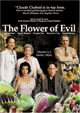
Another place is rather related to the storyline: the Florida room. The crucial scene of the film, the family teatime focused around the reading of the libelous leaflet, unwinds here. One perceives its importance from the poster and the title of this feature film from a former critic of Cahiers du Cinéma and an active member of the French New Wave. The characters seem both like wild beasts hidden in a jungle (which is their own family) and choked by these same plants through lack of oxygen. The scene in which Michèle and Aunt Line are locked up in the bird cage is very revealing and prefigures the intermingled and similar destinies of these two women, well before the crime is committed.
Moreover, the crime doesn't add anything else since another crime had already taken place anyway in the Charpin-Vasseur family! The crime is transmitted as this old family residence (the reconstitution of the Forties at the time of the credits is the work of a goldsmith). The murder committed at the end of film is in fact defused from the very beginning; if you pay attention an assassinated man is seen.
Chabrol enjoys himself by scratching at politics (the posters of the countryside are jewels of humour and ridicule). Aunt Line's father, Pierre, who only appears in the film by way of other characters, strangely resembles a certain native of Bordeaux named Papon (a World War II collaborator who was hidden by the church)...the keystone of this theme is shown with the delightful scene of the HLM's election campaign visit (HLM is subsidized housing).
The true central theme of this opus is the question of culpability: How can one live from generation to generation and have that be transmitted? Which effects can a non-expiated fault have on the culprit and his descendants? The criticism of an encrusted middle-class, immutable in its own straightjacket, does not wait: hypocrisy bursts onto the screen from the first images.
The last pronounced sentence, heavy with meaning is "Let's try to put up a good show." And if the flower of evil were growing near you?
Laurence Nicoli

 French Movies: Reviews 2012 - present French Movies: Reviews 2012 - present
French Films: 1998 - 2011 Reviews
French Music Reviews
|
|