|
Bug review
:. Director: William Friedkin
:. Starring: Ashley Judd, Michael Shannon
:. Running Time: 1:35
:. Year: 2006
:. Country: USA
|
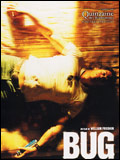
It is almost a requirement to see Bug with an open mind, without even knowing what it's about. It's easier to then effectively plunge into this story of gradual madness, timid mistrust to beginning doubts before being carried into a crescendo as surreal as it is alarming, with an apocalyptic finale. William Friedkin delivers a major work here, not refusing self-citation (an incredible scene where Peter goes into a sort of epileptic fit that makes Linda Blair look like a ballerina, throwing his ruined body onto the bed). Bug is a film which, under his stylistic as well as narrative control, marks the great return of the one of the masters of American cinema.
The world is going badly. With this troubling and funny adaptation of a play by Tracy Letts (who also wrote the script), the author of The Exorcist and French Connection delivers a black vision of a world suffering from a paranoia generated by terrorist threats, wars and all kinds of other secret manipulations: mystical, political, economic.
Agnes (Ashley Judd), a waitress living in fear of her husband's release (played by Harry Connick, Jr.) from prison, bathes in the sordid loneliness of her motel room lost in the desert. While she waits on Peter, a strange vagrant who speaks in enigmas, she believes she's found company to fill an existential vacuum. Except here we have an invasion of insects (that they alone can see) and the young man's insane conspiracy theories involve her little by little into the most radical madness.
From the beginning, Friedkin instills an anxiety that doesn't let go of the audience until the trauma of the final scenes. The exponential uneasiness contained in the film is balanced with a deliciously incongruous humor. Aerial shot of a lost road in the night with the noise of a helicopter in the distance. The camera slowly approaches the motel lights, a decoration of the almost totally claustrophobic atmosphere of the film. Even before the arrival of the so-called insects, which is the trigger that sets off the actors' madness, underlying anguish reigns in the details of the setting: from the décor to the soundtrack and the physical acting of the main characters. Close-ups on a telephone which does not stop ringing until the receiver is picked up, on the humming air-conditioning, on the ventilator of the ceiling light, ready to decapitate...as many elements which allow one to think that this motel room will soon be the theatre of a terrible drama which will stay with the audience long after the credits roll.
The success of this unclassifiable film also holds in the incredible work of the actors, with Ashley Judd and Michael Shannon at the head. Shannon manages to confer an apparent innocence to his character, and to impose a progressive transformation on his body, his self-mutilations (scarring and pulling out a tooth without anesthetic) frightening in their suddenness and their violence. The actress gives herself the luxury of flirting with theatrics in the last twenty minutes. This by no means harms the work, since these excesses of acting intervene when their madness reaches its climax, when nothing seems real, when reason has definitely left their minds: the minds of protagonists, recluses in their cocoon of crazy love, even that of the audience, taken by the throat by tension pushed to the extreme, the surreal backdrop, the delirious dialogue and the violence of the final scenes.
Bug can't leave anyone indifferent. Through its stylistic excess and the radical nature of its subject matter, it is placed among the most successful of Friedkin's films.
Moland Fengkov
Translated into English by Anji Milanovic

 Movie Reviews: 1998 - 2011 Movie Reviews: 1998 - 2011
Movie Reviews: 2012 - present
|
|