|
After the Apocalypse review
:. Director: Yasuaki Nakajima
:. Starring: Yasuaki Nakajima, Jacqueline Bowman
:. Running Time: 1:11
:. Year: 2004
:. Country: USA
|
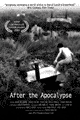
An avatar of 80's Italian cinema, the post-apocalyptic genre has rarely been a field of experimentation for humor—at least not intentionally—or intellectualization—Andrei Tarkovski's Stalker being the greatest exception. Shot in black and white, Yasuaki Nakajima's first film centers around five survivors trying to cope with their new life in an alienated world. Stripped of the most basic communication tool, the use of language has been eradicated by destructive gasses, so they must mostly rely on their instinct to interact with each other, thus being retrograded into a primitive state despite their modern intelligence.
While coupling and food have the highest value in this new world, human life and art are still somewhat respected—Yasuaki, also in the lead role, has been saved from drowning and Jacqueline (Jacqueline Bowman), the only woman here, is a painter. The film follows the encounter of these five individuals who despite their differences—several races and cultural backgrounds are represented here—must learn how to live with each other. The presence of a woman will obviously be a source of chaos but in the end, despite being deprived of civilization's lifestyle and rules, they still can react as human beings.
With its black & white taint and its strong touches of absurdity and poetry, Nakajima's cinema resonates with the influence of the early works of director Jim Jarmusch—and not David Lynch as I read somewhere. Using a setting similar to pictures like Stranger Than Paradise & Down By Law (one will even notice the juggler who is reminiscent of a Roberto Begnini character), Nakajima has built his personal universe with his own cinematographic language, based on images and sounds rather than explicit narrative and dialogue.
There are some moments of bare and rough beauty in After the Apocalypse—most particularly the scene where they draw a baby on a wall—and he successfully manages to ensnare us in his world, despite the absence of words. The black & white cinematography is a perfect echo of the desolate surroundings and the modernistic soundtrack adds to the bizarre atmosphere.
There is however one scene marked by the experimental-film-student-syndrome, which depicts Yasuaki masturbating. Even though this can clearly be interpreted as exposition for the lack of women, I'm still wondering why so many young filmmakers end up filming themselves in black & white nude and masturbating as the ultimate act of experimentation/art—if you don't believe me go to your local film school. Would it be a masochistic ritual where the artist offers himself as a whole to the screen, or pure provocation, these kinds of scenes seem to have lost their impact, especially after having been trivialized in American teen comedies.
With its experimental look & feel, After the Apocalypse is a film to be approached as an experience, rather than as standard plot-fueled fare, and the daring first picture that undoubtedly showcases Nakajima's talent.
Fred Thom

 Movie Reviews: 1998 - 2011 Movie Reviews: 1998 - 2011
Movie Reviews: 2012 - present
|
|